Moving to Another State in 2026: Should You Rent First or Buy Right Away?
A relocation decision guide for comparing renting first versus buying immediately after moving to another state.
Moving to another state turns a normal housing decision into a relocation decision. You are not only choosing a home. You are choosing a tax environment, commute pattern, school system, insurance market, cost of living, climate risk, and lifestyle.
That is why “rent or buy?” is not enough. The better question is: “How much uncertainty am I taking on by buying immediately?”

Quick answer
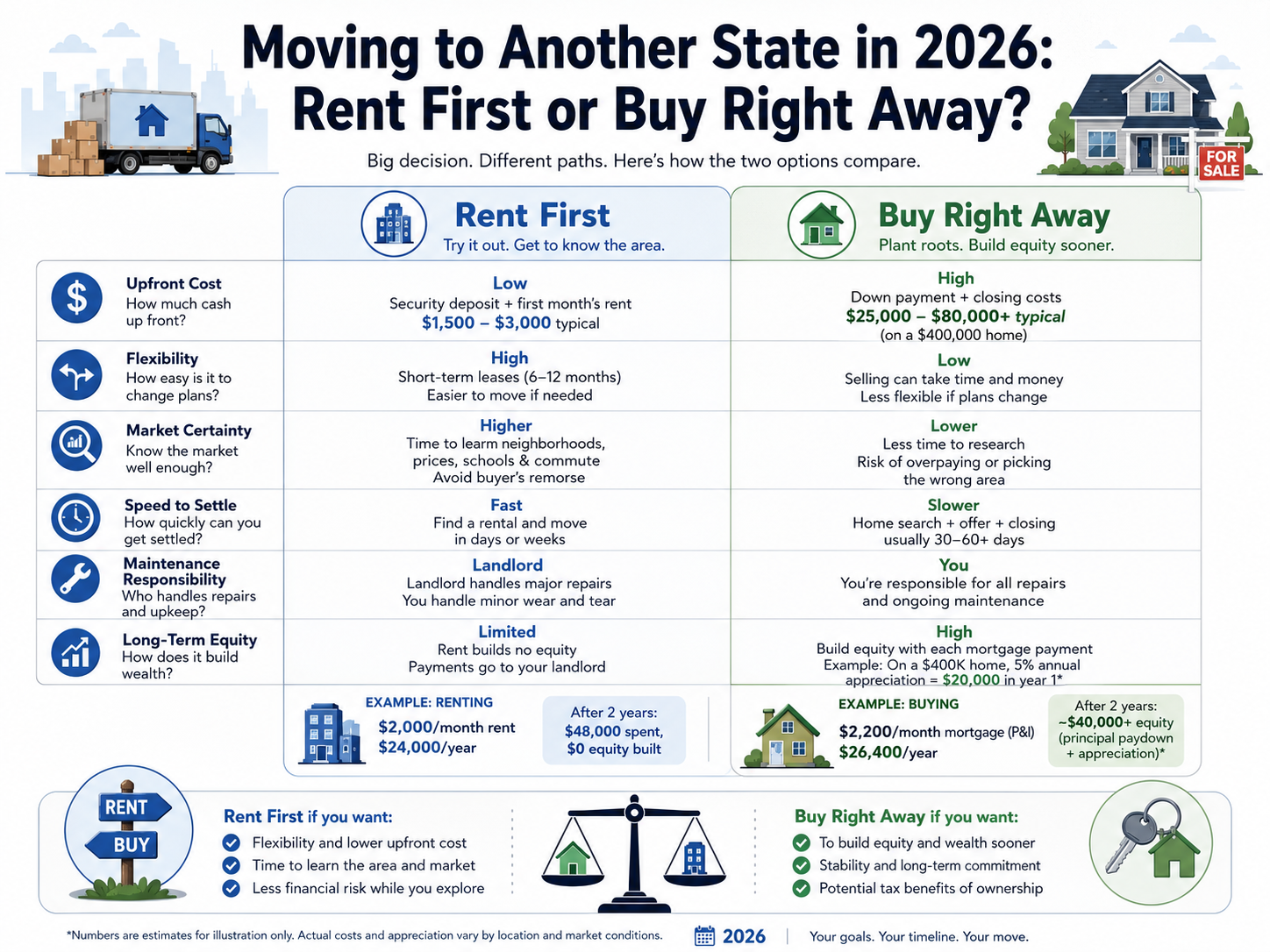
If you are moving to another state in 2026, renting first is usually safer when your job, neighborhood preference, commute, school fit, income, or long-term plans are uncertain. Buying right away can make sense if your move is stable, you know the area well, you plan to stay long enough, and the home passes a full rent-vs-buy and resale-risk analysis.
The risk of buying immediately is not only financial. It is also the risk of choosing the wrong neighborhood before you understand daily life there.
The relocation decision is different from a normal rent-vs-buy decision
A local buyer often understands neighborhoods, traffic, weather, taxes, insurance, schools, and local prices. A relocation buyer may be learning all of that at once.
That information gap has value. Renting first can buy time to learn. Buying immediately can save a move and start equity sooner, but it reduces flexibility.
When renting first is usually smarter
You have not lived in the area before
Online research is helpful, but it does not replace daily life. Commute noise, traffic patterns, weekend routines, grocery access, neighborhood culture, and weather can feel different after a few months.
Your job situation is new
If the move is tied to a new job, new office location, probation period, variable income, or remote-work uncertainty, renting first can reduce risk.
You are choosing between several neighborhoods
Renting lets you test the area before committing to a purchase. This matters when school boundaries, commute times, safety perception, or lifestyle differences are hard to judge from a distance.
The cost of buying is much higher than renting
If ownership cost is far above rent, the flexibility of renting becomes more valuable.
Insurance, taxes, or HOA costs are unfamiliar
Some states and counties have very different tax and insurance patterns. A home that looks affordable by price can become expensive through operating costs.
When buying right away can make sense
You know the area well
If you previously lived there, have family there, or spent significant time in the target neighborhoods, the information gap is smaller.
Your timeline is long
If you are confident you will stay seven to ten years or longer, buying immediately has more time to overcome transaction costs.
Inventory is limited and the right home is rare
Some homes are hard to replace. If you find a property that fits location, layout, schools, and long-term budget, buying may be reasonable.
The rent-vs-buy numbers are favorable
If the full ownership cost is close to rent and resale risk is manageable, buying may become attractive sooner.
You have strong reserves after closing
Relocation creates surprise expenses. Buying right away is safer when you still have cash after down payment, closing costs, moving, furniture, repairs, and emergencies.
The relocation checklist before buying in another state
1. Compare state and local taxes
Income tax, property tax, transfer taxes, vehicle taxes, and local assessments can change the total cost of living. Do not rely on the home price alone.
2. Compare insurance availability and premiums
Homeowners insurance can vary widely by state and risk type. Get quotes early, especially in areas affected by wildfire, wind, hail, hurricane, or flood risk.
3. Compare rent against ownership cost
Rent is the cost of flexibility. Ownership is the cost of control plus potential equity. If the ownership premium is high, the flexibility may be worth paying for temporarily.
4. Test commute and daily routine
Drive or map the commute during actual rush hour. Check school drop-off, grocery trips, medical access, airport access, and weekend traffic.
5. Check local property norms
Different states have different norms for inspections, attorney review, due diligence, disclosures, septic, wells, surveys, HOAs, and closing timelines.
6. Evaluate climate and maintenance differences
Snow, humidity, wildfire defensible space, hurricanes, flood zones, basements, crawl spaces, irrigation, pools, and pest issues can all change ownership cost.
7. Decide how much uncertainty you can afford
If buying the wrong home would be financially painful, rent first. If the downside is manageable and the long-term fit is strong, buying may work.
Example: relocating from California to Texas
A household moving from California to Texas may see larger homes and no state income tax, but they should also examine property taxes, homeowners insurance, HOA fees, utility costs, and climate-related risks.
| Decision factor | Rent first | Buy right away |
|---|---|---|
| Neighborhood knowledge | Can learn over time | Must choose now |
| Cash needed upfront | Lower | Higher |
| Flexibility | Higher | Lower |
| Equity building | Delayed | Starts immediately |
| Wrong-neighborhood risk | Lower | Higher |
| Moving twice | Possible | Avoided |
| Resale risk | Avoided initially | Immediate |
The right answer depends on the household. A remote worker unsure of the best suburb may rent first. A family moving back to a known area with long-term school plans may buy immediately.
How to use RentCast data for stronger relocation content
For a data-backed version of this article, generate static snapshots for representative markets. Useful fields include median rent, rent estimates for sample property types, sale-price trends, rent trends, value estimates, and comparable properties.
How Home Decision Lab helps
Use Rent vs Buy calculator to compare renting first against buying immediately. For a specific property, run a Home Analysis Report at Home Analysis Report.
This article also points toward a future Home Decision Lab relocation analysis that could compare cost of living, taxes, rent, purchase price, job changes, moving costs, property taxes, insurance, and lifestyle fit.
FAQ
Should I rent before buying after moving to another state?
Renting first is often safer if you do not know the area, have a new job, are unsure about schools or commute, or need time to compare neighborhoods.
When should I buy right away after relocating?
Buying right away can make sense if you know the area, have a stable job, plan to stay long term, have enough reserves, and the specific home passes a rent-vs-buy and resale-risk analysis.
How long should I rent before buying in a new state?
Many households rent for six to twelve months, but the right timeline depends on job stability, lease terms, school timing, market inventory, and confidence in the neighborhood.
What costs change when moving states?
Costs that may change include income tax, property tax, insurance, utilities, HOA dues, transportation, childcare, repairs, and local fees.
Is buying immediately risky if I can afford the payment?
Yes, because affordability is only one risk. You may choose the wrong neighborhood, underestimate insurance or taxes, or need to move again before transaction costs are recovered.
How should I compare rent and buy when relocating?
Compare full ownership cost, rent, expected holding period, transaction costs, down payment opportunity cost, future resale risk, and the value of flexibility.
Data sources and assumptions used in this article
This article is educational and uses public market context plus example calculations. Numbers should be refreshed before publishing if Home Decision Lab has newer internal data.
- Freddie Mac Primary Mortgage Market Survey context: 30-year fixed-rate mortgage averaged 6.52% for the week reported June 11, 2026.
- FHFA House Price Index context: U.S. home prices were up 1.7% year over year in Q1 2026 and up 0.5% from Q4 2025.
- U.S. Census/ACS housing-cost framing: ownership cost includes more than the mortgage payment, including taxes, insurance, utilities, fees, and other required housing expenses.
- RentCast can be used for static data snapshots where available: rent estimates, value estimates, comps, property records, listings, and local market trend data. Do not expose an API key in public blog code.
Source URLs:
- https://www.globenewswire.com/news-release/2026/06/11/3310694/0/en/Mortgage-Rates-Average-6-52.html
- https://www.fhfa.gov/reports/house-price-index/2026/Q1
- https://www.census.gov/acs/www/about/why-we-ask-each-question/housing/
- https://www.census.gov/newsroom/press-releases/2025/acs-5-year-estimates.html
- https://developers.rentcast.io/reference/rent-estimate-long-term
- https://www.rentcast.io/api
Educational disclaimer
Home Decision Lab is an educational decision-support tool, not a lender, real estate broker, tax advisor, or financial advisor. This article should not be treated as personal financial, legal, lending, investment, or tax advice. Buyers and homeowners should confirm numbers with qualified professionals before making an offer, refinancing, selling, renting, or moving.
Educational only. This is not financial, legal, tax, mortgage, investment, or real estate advice.