Home Value vs. What a House Is Worth to You: How to Calculate Your Personal Offer Price
A buyer framework for separating market value from personal decision value and building a smarter offer price.
A home can be worth $750,000 to the market and only $700,000 to you. It can also be worth more to you than the average buyer because it solves a specific life problem: location, schools, family proximity, accessibility, pets, work-from-home space, or a rare layout.
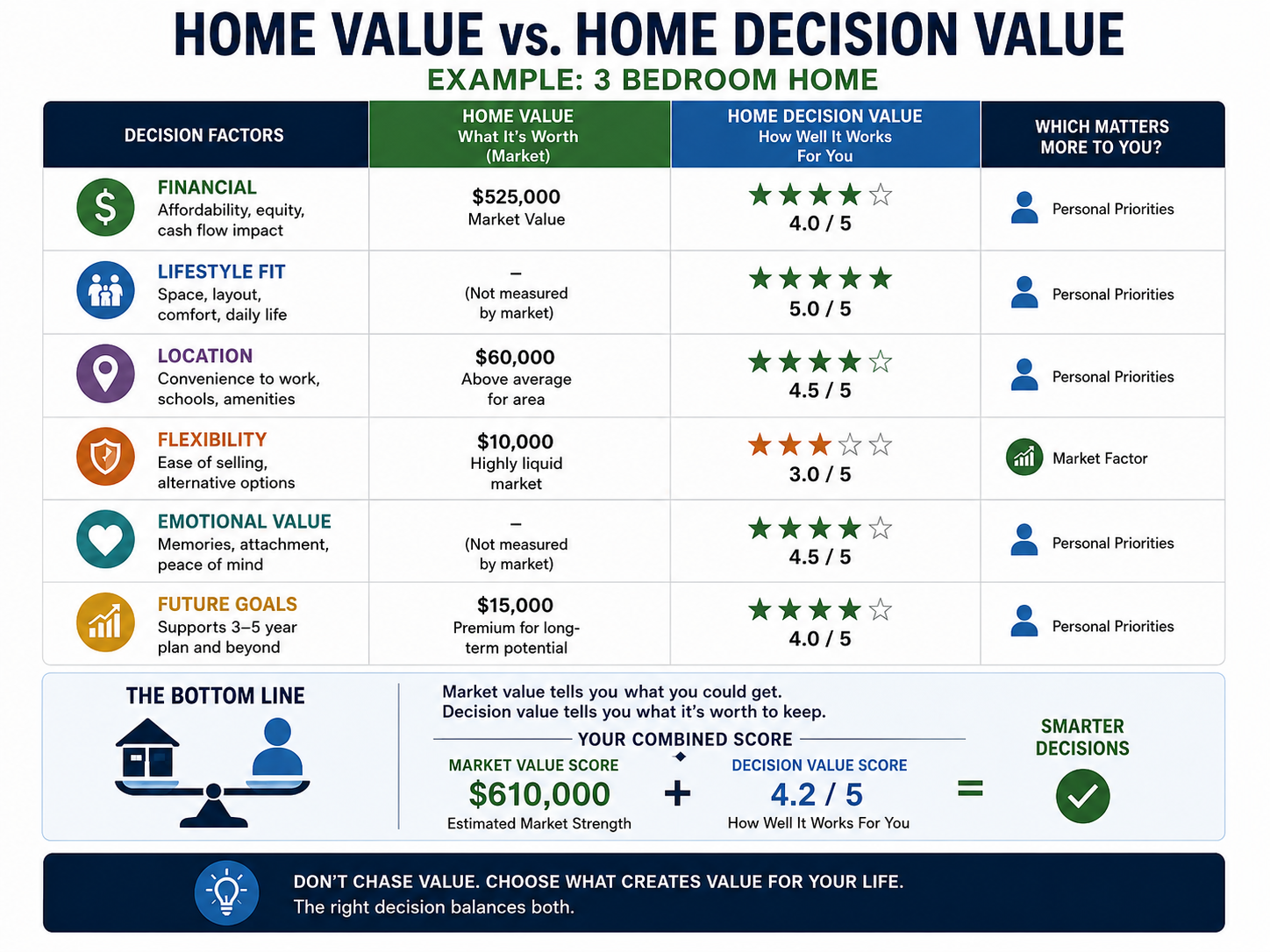
That is why buyers should separate two ideas: market value and decision value.

Quick answer
Market value is what similar homes are selling for. Decision value is what the home is worth to you after adjusting for monthly cost, repairs, rent alternatives, resale risk, timeline, and lifestyle fit. Your offer should be informed by market value, but your walk-away number should be based on decision value.
A fair market price can still be too high for your personal situation.
Market value vs. decision value
Market value
Market value asks: what would a typical informed buyer pay in today’s market?
It uses:
- Recent comparable sales.
- Active competition.
- Property condition.
- Location.
- Lot size.
- Size and layout.
- Market demand.
- Interest rate environment.
Decision value
Decision value asks: what is this home worth to you given your alternatives and risks?
It uses market value plus:
- Your monthly affordability.
- Your expected holding period.
- Repair and maintenance risk.
- Rent-vs-buy comparison.
- Opportunity cost of cash.
- Resale risk.
- Lifestyle fit.
- Flexibility needs.
- Stress tolerance.
The seller cares about market value. You should care about both.
The personal offer price formula
Use this framework:
Personal offer price = supported market value - required repair/risk discount + personal utility premium - affordability adjustment - resale-risk adjustment.
This is not a precise appraisal formula. It is a decision framework.
| Adjustment | Meaning |
|---|---|
| Supported market value | What recent comps justify |
| Repair/risk discount | Cost and uncertainty of repairs or condition |
| Personal utility premium | Extra value because the home fits your life unusually well |
| Affordability adjustment | Reduction if full monthly cost strains the budget |
| Resale-risk adjustment | Reduction if the home may be hard to sell later |
Example: a home listed at $760,000
A buyer likes a home listed at $760,000. Comparable sales support a value around $745,000. The home needs $20,000 of near-term repairs. It has a great location for the buyer, worth a personal utility premium of $10,000. But the full monthly cost is $400 above the buyer’s comfort number, and the home is on a busier street than ideal.
| Item | Amount |
|---|---|
| Supported market value | $745,000 |
| Repair/risk discount | -$20,000 |
| Personal utility premium | +$10,000 |
| Affordability adjustment | -$15,000 |
| Resale-risk adjustment | -$10,000 |
| Personal decision value | $710,000 |
The seller may not accept $710,000. That is okay. The buyer has learned that paying $760,000 would require them to ignore affordability and risk.
How to avoid overpaying because of emotion
Emotion is not bad. You are buying a place to live, not just a financial asset. The problem is when emotion hides the tradeoffs.
Before increasing your offer, ask:
- What number is supported by comps?
- What is my full monthly cost?
- What repairs am I accepting?
- What would I rent instead?
- How long do I realistically expect to stay?
- What happens if I need to sell early?
- Am I paying more because the home fits my life, or because I am tired of searching?
Fatigue is not a reason to overpay. A rare fit may be.
When it is rational to pay above market value
Sometimes paying above recent comps can be reasonable.
The home is unusually scarce
A specific floor plan, lot, school boundary, view, accessibility feature, or multi-generational layout may be hard to replace.
Your timeline is long
If you plan to stay a long time, a modest overpayment may matter less than the utility of the home.
The monthly cost still works
A higher offer is less risky if your full payment remains comfortable and you keep reserves after closing.
The home reduces other costs
A home closer to work, family, school, or childcare may save time and money elsewhere.
When you should not pay the market price
A home can be fairly priced but still wrong for you.
The monthly cost is too high
If the full cost crowds out savings, repairs, childcare, retirement, or emergency reserves, market value is not enough.
The repair risk is unclear
Unknown condition should reduce your offer or increase your inspection protection.
The timeline is short
If you may move in three to five years, transaction costs and resale risk matter more.
Renting is much cheaper and flexible
If renting a similar home is far less expensive, buying needs a strong lifestyle or long-term wealth reason.
How AVMs and estimates should be used
Automated valuation models and rent estimates can be useful starting points. They are not final answers. They may not fully capture condition, layout, upgrades, lot quality, noise, view, HOA health, or buyer-specific preferences.
Use data to narrow the range. Use inspections and personal decision factors to decide your offer and walk-away number.
How Home Decision Lab helps
Run a Home Analysis Report at Home Analysis Report to compare market value, estimated rent, monthly cost, repair risk, and decision value. If you are choosing between buying and renting, use Rent vs Buy calculator. If you already own and are deciding whether to keep a home, use Sell vs Hold calculator.
FAQ
What is the difference between home value and offer price?
Home value estimates what the market may support. Offer price is what you choose to pay based on market value, competition, affordability, repairs, risk, and personal fit.
How do I know what a house is worth to me?
Start with comparable sales, then adjust for monthly cost, repairs, rent alternatives, expected holding period, resale risk, and lifestyle value.
Should I ever offer above asking price?
Offering above asking can make sense in a competitive market if the home’s decision value supports it and the monthly cost remains comfortable. Do not offer above asking just because you are frustrated.
Can a house be worth more to me than to the market?
Yes. A home can have personal value because of location, school, family proximity, layout, accessibility, pets, or lifestyle fit. The key is to decide the maximum premium before negotiating.
What is a walk-away number?
A walk-away number is the maximum price you are willing to pay after considering affordability, risk, alternatives, and personal value. It protects you from emotional escalation.
Are online home value estimates accurate enough to make an offer?
They are useful starting points, but they should be checked against recent comparable sales, property condition, local demand, and your personal decision factors.
Data sources and assumptions used in this article
This article is educational and uses public market context plus example calculations. Numbers should be refreshed before publishing if Home Decision Lab has newer internal data.
- Freddie Mac Primary Mortgage Market Survey context: 30-year fixed-rate mortgage averaged 6.52% for the week reported June 11, 2026.
- FHFA House Price Index context: U.S. home prices were up 1.7% year over year in Q1 2026 and up 0.5% from Q4 2025.
- U.S. Census/ACS housing-cost framing: ownership cost includes more than the mortgage payment, including taxes, insurance, utilities, fees, and other required housing expenses.
- RentCast can be used for static data snapshots where available: rent estimates, value estimates, comps, property records, listings, and local market trend data. Do not expose an API key in public blog code.
Source URLs:
- https://www.globenewswire.com/news-release/2026/06/11/3310694/0/en/Mortgage-Rates-Average-6-52.html
- https://www.fhfa.gov/reports/house-price-index/2026/Q1
- https://www.census.gov/acs/www/about/why-we-ask-each-question/housing/
- https://www.census.gov/newsroom/press-releases/2025/acs-5-year-estimates.html
- https://developers.rentcast.io/reference/rent-estimate-long-term
- https://www.rentcast.io/api
Educational disclaimer
Home Decision Lab is an educational decision-support tool, not a lender, real estate broker, tax advisor, or financial advisor. This article should not be treated as personal financial, legal, lending, investment, or tax advice. Buyers and homeowners should confirm numbers with qualified professionals before making an offer, refinancing, selling, renting, or moving.
Educational only. This is not financial, legal, tax, mortgage, investment, or real estate advice.